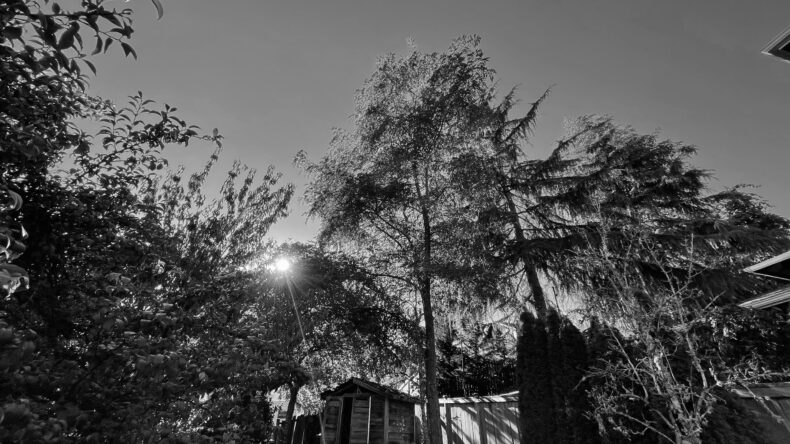
Our neighbors of ten years moved away about a month ago. They were an older couple; L., the husband, was the one we interacted with the most. He was a commercial contractor and drove a big black pickup, but he also made sure to let my wife and me know he had never once voted for Trump. This is Seattle, after all.
As neighbors we were friendly but not overly so. (Again, Seattle.) L. was jocular in a Hail-Fellow-Well-Met kind of way, and we enjoyed occasional chitchat over our shared fence. Once when that fence needed to be replaced, L. was able to leverage his contacts and get us all a discount. For that I was grateful.
This placid cordialness would have been the defining feature of our relationship but for an incident a couple of years ago. One spring afternoon I was doing some yard work when L. came outside and leaned over the fence. “Hey, Eric, got a question for ya,” he said. “What do you think of your tree here?” He gestured to the tree I was at that moment standing under.
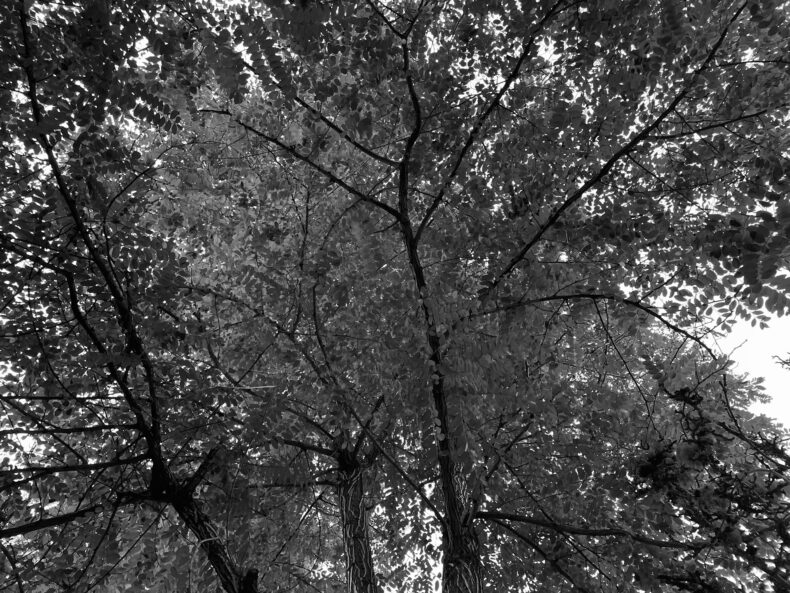
I looked up and considered the tree. It was about forty feet tall. Thin. Small green leaves and white blossoms bedecked its branches.
“I don’t know,” I said. “It’s nice enough.”
L. nodded. “Have you ever thought about cutting it down?”
I smile-grimaced in a way I do when I’m not sure how to respond. “Have I thought about cutting it down?” I said. “No. Why?”
L. explained his thinking. After the tree was done blossoming, its petals fluttered down into his backyard. They were a pain to sweep up. They also had a powerful fragrance, and his wife did not like the way they smelled. So if I didn’t have strong feelings about the tree, it wouldn’t be a huge deal just to, you know, get rid of it.
“Think about it,” he said, and went back inside.
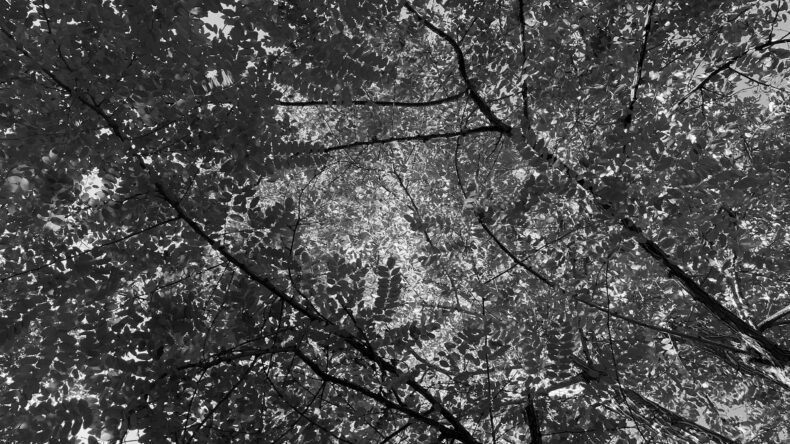
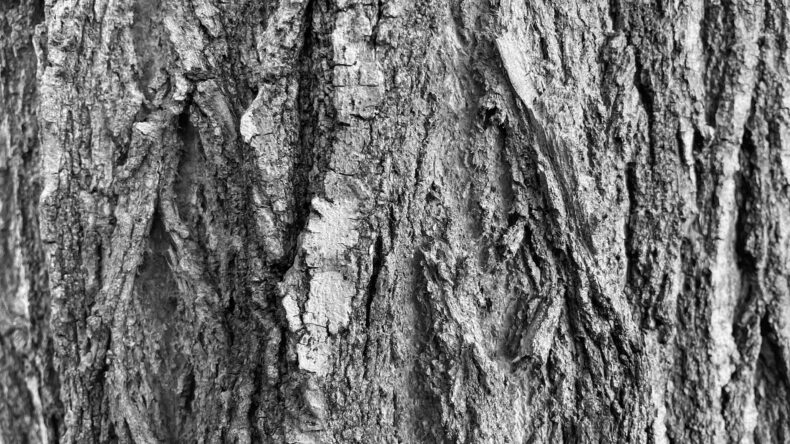
Alone, I again considered the tree. Until that moment, it had just been a tree among other trees. I did not even know what species it was. I got out my phone and took a picture of its bark and leaves and went inside to consult an online plant key. After clicking my way down some forking paths I learned that the tree was a black locust, Robinia pseudoacacia. I learned that it was a member of the legume family, Fabaceae, and that mature specimens might be one hundred feet tall, meaning that at forty feet ours was on the younger side.
Down the black locust rabbit hole I tumbled. I learned they are shade-intolerant and so prefer disturbed areas with dry soils. (Like our yard, I guess.) I learned they can spread not just via seeds that grow in pods, but also with underground shoots. I learned Indigenous peoples used the tough, strong wood to make tools, and chewed the root bark to ease toothaches, and steeped its trunk bark to make tea. I learned that Jean Robin, the herbalist to King Henry IV of France, was given a few of its seeds and planted them in the royal garden in Paris in 1601. I learned that settler colonists used the wood to make houses and fence posts, and the U.S. Navy built ships from it that fought in the War of 1812.
But none of that lore came from my neck of the woods, at least until the mid-1800s, because one of the other things I learned about the black locust was that the species is originally from the eastern U.S. This was a tree of the southern Appalachians and the Ozarks. In the western U.S., and in many other places in the world, it is considered invasive.
“L. asked if we would ever think about cutting down that tree in the backyard,” I told my wife later that evening.
“Which tree?” she asked.
“The tall one in the back. It’s a black locust.”
She frowned. “Why?”
I repeated L.’s rationales.
“And what did you say?”
“I was non-committal,” I said.
My wife rolled her eyes. She sensed I might need a little stiffening of the spine. “Okay, just so I have this straight,” she said. “So because his wife doesn’t like the way a tree smells for about two weeks a year, L. wants us, as he says, to get rid of it? To kill a healthy living thing?”
I hadn’t thought of it that way, but yes, that did seem to be a fair approximation of his request.
“I’ll tell him no,” I said.
“You sure will,” she said.
With no great enthusiasm I awaited L.’s and my next over-the-fence chat. While I did, other anti-tree sentiments he had casually expressed over the years came to mind. Like when he observed the gnarled state of an old apple tree and said I should “put it out of its misery.” Or, more damningly, the time he had mused that I should sneak out in the dead of night and cut down some young madronas that were growing in a vacant lot across the street. “Once they get tall they’ll block your view of the lake,” he said. “But now they’re easier to take care of. And no one will miss them.”
“Trees are the view,” I had said brightly. (I had just seen that slogan on a bumper sticker.)
L. gave me a funny look, like I was some sort of crazed radical. But was I? As a municipality Seattle prides itself on its love of trees. In 1981, the visitors bureau held a contest to come up with a nickname that best captured the city’s essence. The winner, because of all the trees, was “Emerald City.” Depending on the metric and source, Seattle remains one of the more richly treed cities in the U.S. A survey a few years ago found that tree canopy shaded 28.1% of its urban surfaces. City government officials have set a goal of reaching 30% tree canopy cover by 2037. To help achieve this, all sorts of ordinances have been put in place to protect trees.
But Seattleites’ affection for tall greenery can also be parochial and contingent. Tree-related offenses in the area are actually quite common. Some are spectacular in their brazenness. Several years ago, a federal judge was fined more than $600,000 after he had his gardener cut down 120 trees in a public park next to his property. Right now, in one of Seattle’s tonier suburbs, the county is suing a group of homeowners for millions of dollars because they (allegedly) ordered their landscapers to cut down more than one hundred trees in a different public park.
When a tree falls in Seattle, it definitely makes a sound. Even felling just a few trees can incur the city’s passive-aggressive wrath. More than fifteen years ago someone poisoned several trees along a trail near our house. The culprit was never caught, but one look at the house in front of which the trees were growing, with its picture windows facing the Cascades, and the answer to Cui bono was obvious enough. The Seattle Parks Department later placed a plaque near the trees’ stumps. “In memory of seven trees: three silver poplars and four Douglas firs, approximately 70 feet in height, that were fatally damaged by illegal herbicide application in August,” it reads. Then in a larger font: “Whenever a tree is intentionally killed, the whole community feels its loss.”
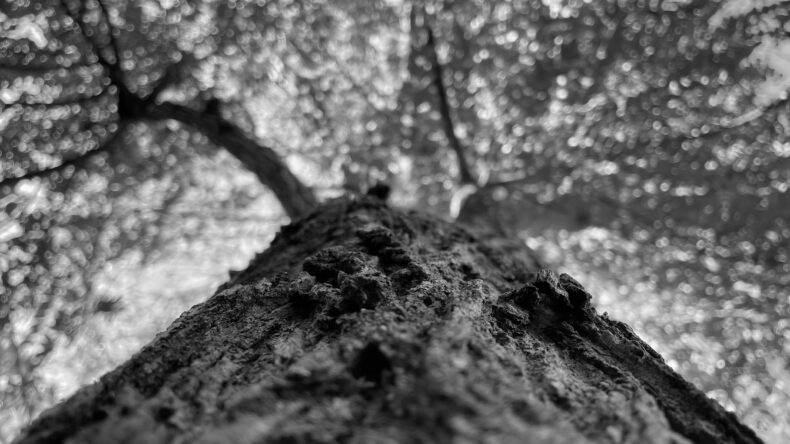
On subsequent wanderings through the neighborhood environs, I started to watch for black locusts. I had a search image now: probably tall, likely thin, furrowed bark, compound leaves, white blossoms (depending on the season), a strong fragrance. Black locusts, I was surprised to see, were everywhere. They grew on the side of the trail, in several city or county parks, in yards all around northeast Seattle. In my casual census, I don’t remember there ever being many black locusts packed together. Instead, one or two would be tucked in with other trees.
The black locusts didn’t look like they were doing any harm, although looks can be deceiving. In King County, the species is designated a Weed of Concern due to its ability to crowd out native plants in meadows, riparian habitats, and along forest edges. “Control,” the county literature states, “is recommended particularly where natural resources are being protected or as part of a stewardship plan.”
I may not know my plants, but as a biologist I am only too familiar with the idea of invasive species. Their origin as a formal academic concern began in 1958, when Charles Elton, an English ecologist who taught at Oxford University, published The Ecology of Invasions by Animals and Plants. He was not the first to remark on introduced species and their effects, but he was the first to systematize their study, and he did so with charged language. “We are living in a period of the world’s history,” he wrote, “when the mingling of thousands of kinds of organisms from different parts of the world is setting up terrific dislocations in nature.” Elsewhere his analogies are more explicitly problematic. “The invader is therefore working his way somehow into a complex system,” he wrote, “rather as an immigrant might try to find a job and a house and start a new family in a new country or big city.”
Invasion ecologists today swear that nativist thoughts never enter their calculations. “A species’ origin is highly correlative with eventual damage,” said Dan Simberloff, a professor at the University of Tennessee and probably the field’s most ardent champion. “To object to that is stupid, and also brings up phony charges of xenophobia.” But other biologists are flummoxed by some of their colleagues’ pro forma sensitivity to the implications of their tropes. They wonder about the value (or values) of a field so obviously political, preoccupied as it is with borders and homelands. “You have all these scientists who are dyed-in-wool Democrats, but you bring up invasive species and they start talking like red meat Republicans,” one biologist told me years ago. “It’s just weird.” He didn’t think future historians were going to be kind to today’s invasion ecologists.
I do not mean to trivialize the varied and substantial costs of non-native species, like Norway rats, zebra mussels, kudzu, or the brown tree snake. But it is still hard to get around the impression that, for all the subtle thoughts that followed, strange notions of fairness seem to lie near the heart of invasion biology. It is like we resent species that can so effectively exploit our inattention, our ignorance, or worst of all, our sentimentality. Invasive species as they spread have a way of making people feel powerless. Seen this way, of course invasion biology will continue. It is the most natural of the natural sciences to come out of the Anthropocene, where science blurs into something a little like hate.
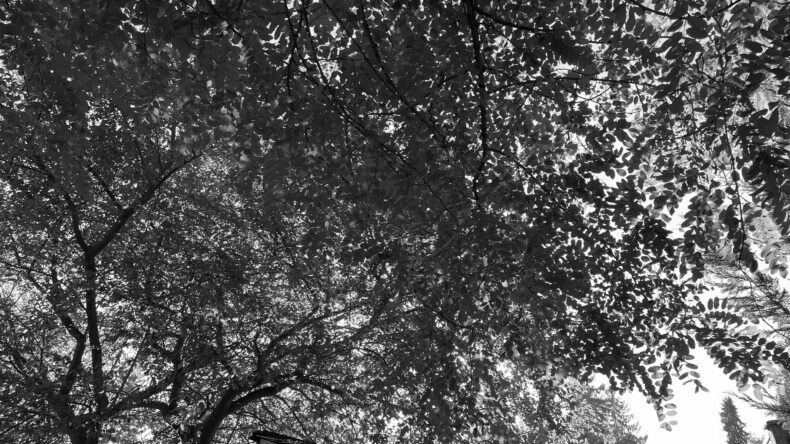
L. had gone out of town for a couple of weeks it turned out. The prospect of defending the black locust in the politest but most unyielding terms when he returned occupied a lot of my morning runs while he was away. I trotted along, testing my arguments, anticipating objections, devising counterarguments. Oh, I was ready to stand for this tree, this complicated tree, this tree I had not even seen until L. asked me to chop it down, a tree that might be invasive, yes, but was so in other more undisturbed habitats, not the middle of a city, and anyway this tree was my tree, in my yard.
Near the end of one run I was really working myself into a good lather for what I assumed would be the inevitable confrontation. Whether I shall turn out to be the hero of my own life (or a tree’s), or whether that station will be held by anybody else, THESE PAGES MUST SHOW. Such was the nature of my thoughts as I galloped down the last hill to our house. By chance my attention strayed to L.’s backyard, and in particular one corner that isn’t visible from the street except from certain vantages. I screeched to a halt, staring in disbelief. There, right behind his house, growing nice and straight and tall—nicer and straighter and taller and more voluptuously floral than our own—was a black locust.
What the almighty heck! I thought. The need for any sort of reasoned argument evaporated. I did what any good Seattleite would do: I completely ignored L.’s request and never brought it up again. L. for his part never mentioned it either. The seasons passed. Our neighbor trees blossomed madly and smelled powerfully and the petals fell all over the place. L. and I chatted amiably over the fence from time to time. Then he and his wife sold their house and moved away. It was like nothing had ever happened.
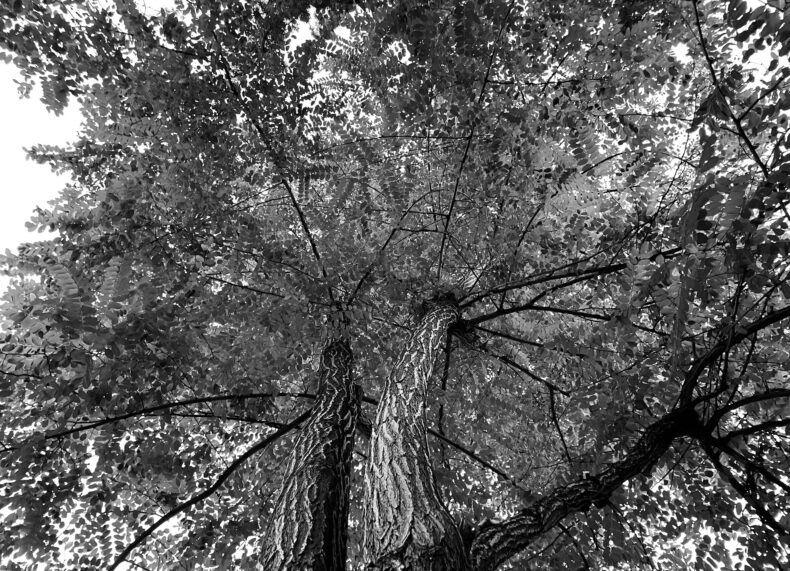
Last weekend I was in the yard considering the black locust, albeit in a less heightened state. Fall has at last arrived, and with it I had turned my attention to the kind of destructive gardening in which I specialize. Some of the locust’s lower branches had grown large enough to reach over the fence, so I thought to prune them, maybe as a gesture for our new neighbors.
I fetched our extendable pruner and hacked away until a couple of the branches fell to the ground. When I grasped them to drag them to the yard waste bin, I yelped and yanked my hand back. A thorn had stuck itself neatly into my palm.
From my earlier researches I knew black locusts could have thorns—had learned that younger trees were more likely to have them all along the branches, sharp and hard and discreet. But as I had never really interacted with the tree before, I had not met its thorns in such a personal way. Now I chafed the thorn out of my hand and stepped away from the tree. Gave it some room. The wind moved through its high branches. They swayed, dappled the ground with shadow. Between the two of us, an uneasy peace.
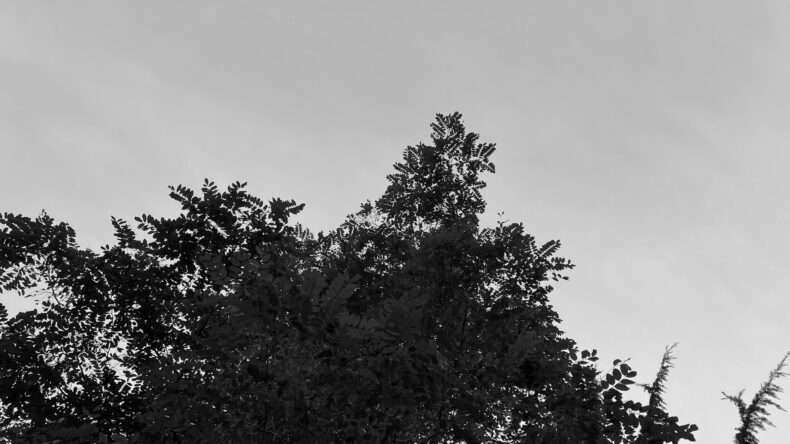
Photos by the author

Honey that bees make out of locust (black and white) flowers is amazingly delicious.
Another reason to let it live.
I love this post. It reminded me of the poem “One Tree” by Philip Metres, which also carries an uneasy peace. (https://onbeing.org/poetry/one-tree/)
Thanks so much, Cameron! And oof, what a poem–thanks for directing me (us) to it. Although I confess I blush a little at all Metres can do with so few words…